
The Future of Digital Transactions Has Arrived
Why This Move Matters
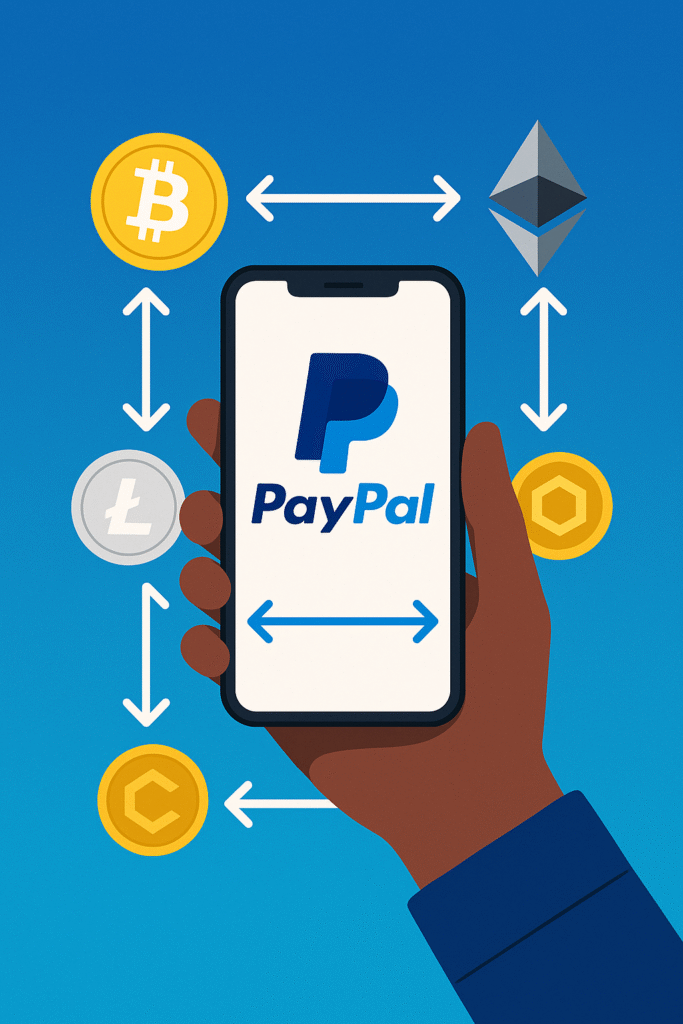
In 2025, a groundbreaking announcement from PayPal took the financial and crypto industries by storm: PayPal Adding Crypto to peer-to-peer payments, allowing direct transfers of Bitcoin (BTC), Ethereum (ETH), and other cryptocurrencies. This isn’t just another product update—it’s a major leap in how people send, receive, and think about money. For years, crypto enthusiasts and skeptics alike debated whether digital currencies would ever integrate seamlessly with mainstream financial tools. Now, with PayPal leading the way, that debate has an answer.
Think about it. Until recently, sending crypto through PayPal wasn’t exactly “peer-to-peer.” Users could buy and sell BTC or ETH within the platform, but transfers were stuck inside PayPal’s ecosystem. If you wanted to send funds elsewhere, you had to cash out into fiat currency first. That friction is now gone. You can send crypto directly—just like you send dollars today. This shift marks PayPal as one of the most influential drivers of mainstream adoption.
This long-form guide explores how PayPal Adding Crypto to peer-to-peer payments impacts beginners, professionals, and entrepreneurs alike. We’ll dive into the history, practical uses, real-life examples, challenges, and the future outlook of this bold move.
Why PayPal Adding Crypto to Peer-to-Peer Payments Matters
1. Breaking Down Barriers Between Fiat and Crypto
For years, crypto skeptics argued that digital currencies lacked real-world usability. PayPal’s move proves otherwise. By enabling direct crypto transfers, it has blurred the lines between fiat and digital money. Sending Bitcoin or Ethereum now feels no different from sending U.S. dollars, but with extra benefits like borderless reach.
2. Trust and Adoption at Scale
PayPal serves over 430 million active users worldwide (2025 data). When a trusted payment giant like PayPal normalizes crypto, it reassures hesitant users who previously worried about volatility, scams, or complexity. This is especially appealing to crypto beginners.
3. A Tool for Every Audience
- Beginners: A simple, familiar entry point to explore crypto without diving into complex exchanges.
- Professionals: A faster, cheaper, and more global way to manage cross-border payments.
- Entrepreneurs: A new revenue stream by accepting crypto for goods and services through PayPal.
The Journey: How PayPal Went from Skeptic to Innovator
Back in 2013, PayPal executives weren’t sold on crypto. Volatility and regulatory uncertainty made Bitcoin seem more like a speculative gamble than a payment solution. Fast forward to 2020, PayPal made its first major leap—offering crypto buying and selling on its app. That announcement alone drove Bitcoin’s price upward and opened doors for millions of first-time investors.
Yet, those early integrations had limits. Users couldn’t move their assets outside PayPal or send them to others. Critics labeled it “crypto in a sandbox.”
Now, with PayPal Adding Crypto directly to peer-to-peer transfers, the walls have come down. This step is equivalent to opening the gates of mainstream adoption. Much like past innovations in digital payments—whether it was Venmo simplifying splits or PayPal itself replacing checks—this move sets the stage for mass usage.
How Peer-to-Peer Crypto Transfers Work in PayPal
Step-by-Step Process
- Open PayPal App → Head to the “Send Money” option.
- Choose Crypto → Select BTC, ETH, or other supported assets.
- Enter Details → Input the recipient’s email, PayPal ID, or wallet address.
- Enter Amount → Decide whether to send in USD equivalent or crypto units.
- Confirm Transaction → Funds are sent instantly.
Supported Cryptocurrencies in 2025
- Bitcoin (BTC)
- Ethereum (ETH)
- Litecoin (LTC)
- Bitcoin Cash (BCH)
- PayPal’s own stablecoin PYUSD
- Other regulated stablecoins like USDC
Security Measures
PayPal’s integration includes two-factor authentication, encrypted transfers, and advanced fraud detection. While PayPal retains custody of the coins (meaning they hold the private keys), it balances security and convenience for the mainstream audience.
Real-Life Scenarios of PayPal Adding Crypto
1. Freelancers and Remote Workers
Imagine you’re a freelance web developer in Brazil working for a U.S. client. Instead of waiting days for Payoneer or wire transfers, you get paid instantly in Ethereum through PayPal. The funds are yours in minutes, not days.
2. Family Remittances
A father in Canada can now send Bitcoin directly to his daughter studying in India—without traditional remittance delays or fees. PayPal makes it as seamless as sending cash.
3. Small Businesses and E-Commerce
A Shopify seller in Europe can now receive payments from U.S. customers in crypto, adding flexibility and attracting crypto-savvy shoppers.
Crypto Adoption by the Numbers (2025 Update)
- Global users: Over 700 million people worldwide own or use crypto.
- Daily transactions: Bitcoin averages 550,000+ transactions daily; Ethereum surpasses 1.2 million.
- Millennial investors: Surveys show 58% of millennials prefer crypto to traditional assets.
- PayPal volume: The company processes over $1.5 trillion annually.
When PayPal Adding Crypto aligns with these numbers, it doesn’t just ride the wave—it amplifies it.
Challenges Ahead
1. Regulations
Governments continue tightening rules around crypto. PayPal must adapt its services across different regions to remain compliant.
2. Custody Debate
Crypto purists say: “Not your keys, not your coins.” Since PayPal manages custody, hardcore decentralization advocates remain skeptical.
3. Transaction Costs
High network fees, especially during peak times on Ethereum or Bitcoin, could limit small-value transfers. PayPal may adopt Layer 2 solutions like the Lightning Network to address this.
Why Entrepreneurs Should Pay Attention
For business owners, PayPal Adding Crypto isn’t just about payments—it’s about growth:
- Expand Market Reach: Sell products globally with no currency conversion hassles.
- Enhance Brand Image: Early adopters of crypto often attract younger, tech-savvy customers.
- Reduce Barriers: Easier transactions mean higher conversion rates.
SEO and Linking Recommendations
- Internal Links:
- External Links:
FAQs: PayPal Adding Crypto to Peer-to-Peer Payments
Q1. Which cryptocurrencies can I send on PayPal?
Supported cryptos include BTC, ETH, LTC, BCH, PYUSD, and USDC.
Q2. Do I need a wallet?
No, PayPal functions as your crypto wallet.
Q3. Can I transfer to external wallets?
Yes, PayPal now allows transfers to external crypto addresses.
Q4. What about fees?
Fees vary depending on the coin and blockchain congestion.
Q5. Is it safe?
Yes, PayPal uses enterprise-grade security, but it remains custodial.
Q6. Will PayPal add more coins in the future?
Most likely. Expect additional stablecoins and possibly DeFi-related tokens.
Conclusion: PayPal’s Bold Step Forward
By PayPal Adding Crypto to peer-to-peer payments, the company isn’t just expanding its features—it’s rewriting how money moves. Whether you’re a freelancer, entrepreneur, or crypto beginner, this update offers opportunities to save time, cut costs, and embrace the future of payments.
This is more than a convenience. It’s a cultural shift. It tells the world that digital currencies aren’t just for traders or tech geeks—they’re for everyone.
Ready to explore crypto payments? Log into PayPal today, try sending Bitcoin or Ethereum to a friend, and experience firsthand how the future of money feels.
Discover how PayPal Adding Crypto to peer-to-peer payments in 2025 enables direct transfers of BTC, ETH, and more. Learn the benefits, challenges, and what this means for freelancers, businesses, and crypto beginners.









%u
Hi, I do think this is a great blog. I stumbledupon it 😉 I am going to come back yet again since I saved as a favorite it. Money and freedom is the greatest way to change, may you be rich and continue to help other people.https://clients1.google.rw/url?q=https%3A%2F%2Fhitommy.net%2Fxe1%2Fmy_thoughts%2F1938575/
Here is my web page – seo united backlink checker
https://www.google.gr/url?sa=t&url=https%3A%2F%2fmy-pet-extra.store
Very great post. I just stumbled upon your weblog and wanted to mention that I
have truly enjoyed surfing around your weblog posts.
In any case I’ll be subscribing to your rss
feed and I hope you write again soon!https://www.google.gr/url?sa=t&url=https%3A%2F%2fmy-pet-extra.store
https://alt1.toolbarqueries.google.com.om/url?q=https://my-pet-extra.store/
Ahaa, its good conversation concerning this article here at this webpage, I have read all that, so at this
time me also commenting here.https://alt1.toolbarqueries.google.com.om/url?q=https://my-pet-extra.store/
https://www.partner-ads.com/dk/klikbanner.php?bannerid=109849&partnerid=27286&htmlurl=https://my-pet-extra.store/
Attractive portion of content. I just stumbled upon your website and in accession capital to say that I acquire in fact enjoyed account your blog posts.
Anyway I’ll be subscribing on your augment and even I success you
access constantly rapidly.https://www.partner-ads.com/dk/klikbanner.php?bannerid=109849&partnerid=27286&htmlurl=https://my-pet-extra.store/